

Table of Contents
ToggleOnline vs In-Person First Aid and CPR Certification Course: Which Option Is Better?
Medical emergencies can happen anytime and anywhere. In such situations, having the right knowledge and skills can help save a life before professional medical assistance arrives. This is why joining a professional first aid and CPR certification course has become essential for individuals, parents, teachers, healthcare workers, and corporate professionals who want to develop life-saving emergency response skills.
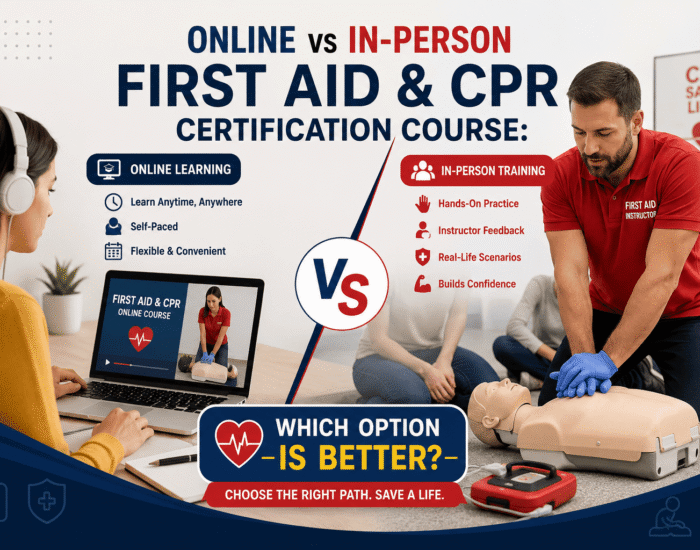
Today, people have multiple options to obtain their certification, including online courses and traditional classroom-based training. While both methods aim to teach life-saving techniques, they differ in terms of learning experience, flexibility, practical exposure, and skill development. Online courses offer convenience and self-paced learning, while in-person classes provide direct instructor guidance and hands-on practice.
So, the question remains: Which option is better—online or in-person first aid and CPR certification? Let’s understand the differences and choose the right learning method for your needs.
What Is an Online First Aid and CPR Certification Course?
An online first aid and CPR certification course is a convenient way to learn the basics of emergency care from anywhere. Instead of attending a classroom, learners can access video lessons, study materials, demonstrations, and online assessments through a digital platform. This makes it easier to learn important first aid and CPR concepts without having to travel to a training center.
One of the biggest advantages of online CPR certification is flexibility. Learners can study at a time that fits their schedule and go through the lessons at their own pace. This can be especially helpful for working professionals, students, parents, and others with busy routines. Online training can also be useful for revising first aid knowledge and understanding the correct steps to take during an emergency before attending practical training.
Advantages of Online CPR Certification
- Learn anytime and from any location.
- Flexible schedule suitable for busy lifestyles.
- Easy access to digital learning resources.
- Cost-effective compared to some classroom programs.
- Ideal for reviewing first aid concepts and emergency procedures.
Limitations of Online CPR Training
- Limited opportunities for hands-on practice.
- No immediate instructor feedback during technique practice.
- Less exposure to real-life emergency simulations.
- Practical skills such as chest compressions and AED usage may be difficult to master without physical practice.
What Is an In-Person First Aid and CPR Certification Course?
An in-person first aid and CPR certification course takes place in a classroom or training center under the guidance of a certified instructor. Participants learn through live demonstrations, practical exercises, group activities, and emergency response scenarios.
Classroom-based CPR training allows students to practice essential skills, such as performing CPR on adults, children, and infants; using an Automated External Defibrillator (AED); controlling bleeding; and managing choking emergencies. The instructor can observe techniques and provide immediate corrections, helping participants build confidence for real-life situations.
Advantages of In-Person CPR Certification
- Hands-on practical experience.
- Real-time feedback from certified instructors.
- Better confidence in handling actual emergencies.
- Opportunity to practice CPR techniques and AED usage.
- Interactive learning through emergency scenarios.
Limitations of In-Person Training
- Fixed class schedules.
- Requires traveling to the training location.
- May take more time compared to online learning.
Online vs In-Person CPR Training: A Quick Comparison
Feature | Online Training | In-Person Training |
Learning Flexibility | High | Limited to scheduled sessions |
Hands-On Practice | Minimal | Extensive practical training |
Instructor Support | Limited | Direct guidance and feedback |
Convenience | Learn from anywhere | Requires physical attendance |
Confidence Building | Moderate | Higher due to practical experience |
Real-Life Emergency Practice | Limited | More realistic simulations |
Which First Aid and CPR Certification Option Is Better?
Choosing between online and in-person first aid and CPR certification depends on your schedule, learning style, and training needs. If you prefer to learn at your own pace and mainly want to understand the basic concepts of first aid and CPR, an online course can be a convenient option. It can be particularly useful for busy professionals, students, or anyone looking to refresh their existing knowledge.
On the other hand, an in-person first aid and CPR certification course can be a better choice if you want hands-on experience and greater confidence in responding to an emergency. Learning under the guidance of an instructor gives you the opportunity to practice important skills, ask questions, and receive feedback while performing CPR and other emergency procedures.
For those who want the flexibility of online learning along with practical experience, a blended course can be a good option. It combines online learning with hands-on training, helping learners understand the theory while also developing practical emergency response skills.
Conclusion
Choosing between online and in-person first aid and CPR certification depends on how you prefer to learn and the level of practical experience you require. Both formats provide valuable emergency knowledge, but hands-on CPR training often helps individuals develop greater confidence and accuracy when responding to real-life situations.
A professional first aid and CPR certification course equips you with essential life-saving skills, including CPR techniques, AED operation, and basic emergency care. Whether you choose online, in-person, or blended learning, obtaining a recognized CPR certification is a responsible step toward creating a safer home, workplace, and community.