

Table of Contents
ToggleTypes of CPR Training Everyone Should Know
Every year, millions of people lose their lives due to sudden cardiac arrest in both rural and urban areas. One of the major reasons behind this is the lack of basic medical knowledge and immediate assistance during emergencies. This raises an important question: how can we control this growing crisis? The answer lies in CPR (Cardiopulmonary Resuscitation)—a life-saving technique that can help keep a person alive until professional medical help arrives. However, many people are unaware that there are different types of CPR training, each designed for specific situations and age groups.
In this article we will guide about the types of CPR training everyone should know, how they differ, and which one is right for you.
What is CPR?
CPR is a life-saving skill technique use during a cardiac emergency to maintaining blood flow and oxygen to vital organs until professional medical help arrives.
In simple terms, CPR equips you with life-saving skills such as chest compressions, rescue breathing, and the use of an AED (automated external defibrillator).
Why CPR is Important to learn?
Proper knowledge of CPR training knowledge
- Increases survival chances during cardiac arrest
- Helps you act confidently in emergencies
- Essential for workplaces, schools, and public safety
- A valuable skill for both professionals and non-professionals
- Even basic knowledge of CPR can make a huge difference in saving lives.
What Are the Types of CPR Training?
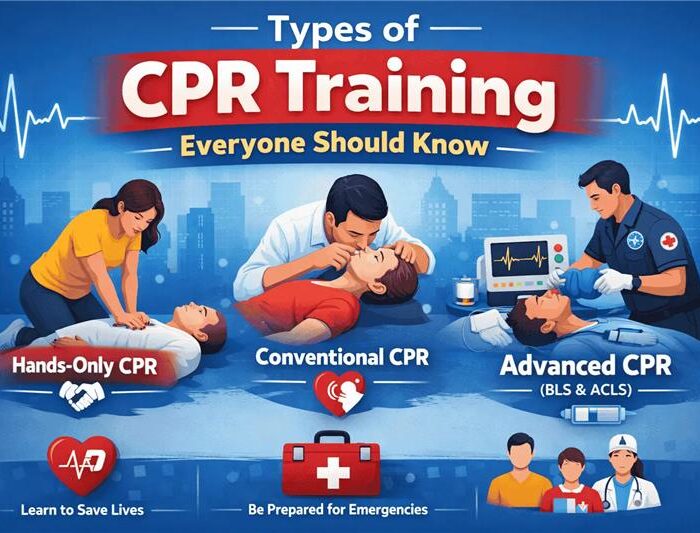
There are 3 types of CPR are Hands-Only CPR, Conventional CPR (Compressions + Breaths), and Advanced CPR (BLS + ACLS).
1. Hands-Only CPR: Hands-Only CPR focuses only on chest compressions without rescue breaths. It is simple, effective, and ideal for individuals.
What it includes:
- Continuous chest compressions
- No mouth-to-mouth breathing
Best for:
- Bystanders
- Beginners
- People who hesitate to perform mouth-to-mouth CPR
2. Conventional CPR (Compressions + Breaths): Conventional CPR combines chest compressions with rescue breathing to maintain blood circulation and provide oxygen to the body.
What it includes:
- Chest compressions to maintain blood flow
- Rescue breaths (mouth-to-mouth) to supply oxygen
Used for:
- Children and infants
- Drowning victims
- Breathing-related emergencies
3. Advanced CPR (BLS + ACLS): Advanced CPR includes high-level life-saving techniques used by trained medical professionals to manage critical emergencies.
It combines Basic Life Support (BLS) and Advanced Cardiovascular Life Support (ACLS) to provide more effective and coordinated care.
What it includes:
- High-quality chest compressions and ventilation
- Advanced airway management (such as intubation)
- Use of life-saving medications
- Cardiac monitoring (ECG)
- Team-based emergency response
Best for:
- Doctors and physicians
- Nurses and paramedics
Why Everyone Should Learn CPR Training
CPR training is not just for medical professionals—it is a life-saving skill for everyone.
- Cardiac arrest can happen anywhere
- Immediate action can save lives.
- Helps protect your family and community.
- Builds confidence in emergency situations.
Final Thoughts
Understanding the types of CPR helps individuals choose the right first aid training program for based on their interest to prepares them for real-life emergencies. Each type of CPR training serves a unique purpose, whether you are a beginner, a parent, or a healthcare professional.
Learning CPR is not just a skill—it’s a responsibility that can help save lives when every second counts.
so if you are planning to join a participate in a CPR and first aid training Magic Eye First Aid is here to guide you.
Frequently Asked Questions
The main types of CPR training include Hands-Only CPR, Conventional CPR, and Advanced CPR (BLS + ACLS).
Hands-Only CPR and basic CPR certification courses are best for beginners.
CPR training is not mandatory for everyone but is required in many healthcare and corporate roles.
CPR certification usually remains valid for 1–2 years, depending on the training provider.