

Table of Contents
ToggleFirst Aid and CPR Training Programs in India: Types, Duration, Cost, and How to Choose
A colleague collapses at his desk. A child suddenly chokes on food at home. A driver is injured on the road, and a crowd gathers, but nobody knows what to do. In India, situations like these happen every day, and in most of them the first few minutes decide the outcome.
The good news is that anyone can learn these life-saving skills through a proper first aid and CPR training program. Today, many institutes offer first aid and CPR training programs for companies, schools, healthcare staff, and everyday people. The harder part is choosing a program that is practical, properly certified, and suitable for your needs.
This guide explains the main types of programs, how long they take, what they typically cost in India, and how to pick a provider you can trust.
Why First Aid and CPR Training Matters in India
Sudden cardiac arrest, road accidents, burns, choking, falls, and workplace injuries can happen to anyone. Ambulances may take time to arrive, especially in traffic or in smaller towns. What someone nearby does before help arrives often determines whether the patient survives and how well they recover. When CPR is started early, it keeps blood and oxygen moving to the brain and heart until professionals take over. Basic first aid, such as stopping bleeding, cooling a burn, or keeping an injured person still, prevents a bad situation from getting worse.
Trained people also stay calmer. Panic is one of the biggest barriers in an emergency, and practice builds the confidence to act.
What Do First Aid and CPR Training Programs Include?
A good program combines short theory sessions with a lot of hands-on practice. Most programs cover:
- First aid basics: assessing a scene, checking responsiveness, calling for help, and staying safe.
- Wound care: controlling bleeding, cleaning and dressing wounds, and bandaging.
- Injuries: burns, fractures, sprains, and how to move an injured person safely.
- Medical emergencies: shock, stroke, diabetic emergencies, fainting, poisoning, and electric shock.
- Choking and breathing problems: how to help adults and children who cannot breathe.
- CPR: chest compressions, rescue breaths, and teamwork during resuscitation.
- AED use: how an automated external defibrillator works and how to use it step by step.
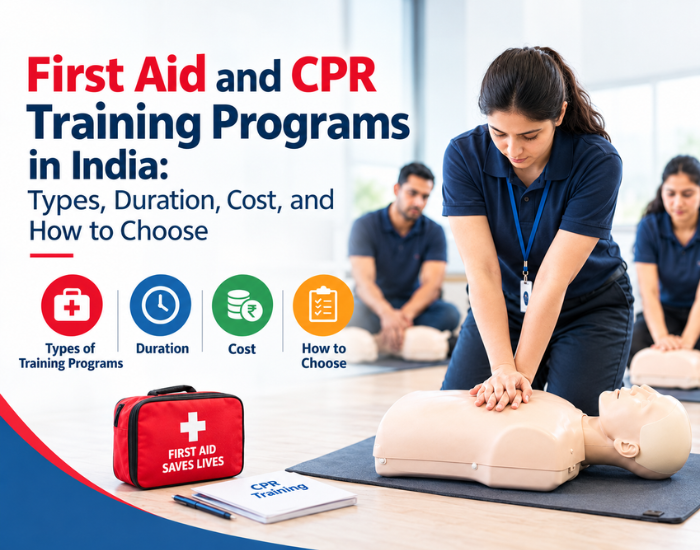
Participants usually practice on manikins so they can feel the correct depth and rhythm of compressions. For adults, the commonly taught rate is about 100 to 120 compressions per minute.
Types of First Aid and CPR Training Programs in India
Not every program suits every person. Here are the main types.
Basic First Aid and CPR Program
This is the starting point for most people. It covers common injuries and illnesses, adult CPR, and basic AED use. It suits office staff, teachers, parents, hotel and retail employees, security staff, and anyone who wants general preparedness.
First Aid Certification Course
A first aid certification course goes a little deeper and ends with a formal assessment and a certificate. Employers often ask for this certificate for compliance, safety audits, or hiring. If you want something you can show to your company or a client, this is usually the right choice. You can see what such a course covers on the First Aid and CPR certification course page.
Basic Life Support (BLS)
BLS is designed for healthcare providers such as doctors, nurses, paramedics, lab staff, and ambulance crew. It focuses on high-quality CPR, team-based resuscitation, airway support, and AED use. If you work in a clinical setting, read about the Basic Life Support (BLS) course.
Advanced Cardiac Life Support (ACLS)
ACLS is the next level for healthcare professionals. It covers cardiac rhythm recognition, emergency medication, advanced airway management, and leading a resuscitation team. It usually requires a BLS foundation. Details are on the ACLS certification course page.
Corporate and On-Site Programs
Many organizations prefer to train employees at their own office, factory, or campus. Instructors travel to the site, and the session can be scheduled around shifts. This format works well for manufacturing units, IT parks, hospitality businesses, and any workplace that wants a trained first aid team.
School, College, and Community Programs
These are shorter, simpler sessions for students, teachers, housing societies, and community groups. They are usually practical and easy to follow, with a focus on choking, bleeding, fainting, and basic CPR.
How Long Do These Programs Take?
Generally, a first aid and CPR training institute decides the duration of a program based on the course level and the number of participants. The ranges below are typical, and actual timings vary by provider.
| Program type | Typical duration | Best for |
| Basic first aid and CPR awareness | 3 to 4 hours | Employees, parents, community groups |
| First aid certification course | 1 day (6 to 8 hours) | Workplaces needing a certificate |
| BLS | 4 to 6 hours | Doctors, nurses, paramedics, students of healthcare |
| ACLS | 2 days | Hospital teams, emergency and ICU staff |
Smaller batches usually mean more practice time on the manikin for each person, so ask about batch size before you book.
How Much Do First Aid and CPR Training Programs Cost in India?
Prices differ by city, course level, certifying body, group size, and whether training happens at your site or the provider’s center. As a rough guide:
- Basic first aid and CPR: This is usually the most budget-friendly choice, and group or corporate bookings often work out cheaper per person.
- First aid certification course: costs a little more because it includes assessment and a formal certificate.
- BLS: priced higher than basic first aid because it follows a healthcare-provider standard.
- ACLS: the highest of the four, since it is longer and more advanced.
These are general trends, not fixed prices. Rather than choosing only on price, ask what the fee includes. Check for the certificate, study material, manikin practice, AED training, and any re-certification support. A very low price with no hands-on practice is not good value.
How to Choose the Right First Aid and CPR Training Program
Use this checklist when you compare providers.
- Check the certification and accreditation. Ask which body the certificate comes from and whether instructors are certified by recognized organizations such as the American Heart Association or St. John Ambulance. Ask whether you can verify a certificate later.
- Look at the instructors. Experienced trainers with real emergency or clinical knowledge teach better than someone reading from slides. Ask about their qualifications.
- Insist on hands-on practice. Reading about CPR is not the same as doing it. The program should give every participant time on a manikin and an AED trainer.
- Match the course to your role. A teacher, a nurse, and a factory supervisor have different needs. Choose basic first aid, a first aid certification course, BLS, or ACLS accordingly.
- Ask about batch size and format. Smaller groups get more attention. If you are an employer, check whether on-site training is available.
- Confirm the validity and renewal. Most CPR certifications are valid for about two years. Ask how renewals work, since guidelines are updated from time to time.
- Read reviews and ask for references. Feedback from other companies and participants shows how practical and well-organized the training really is.
Who Should Take a First Aid and CPR Training Program?
Almost everyone benefits, but these groups should especially consider it:
- Corporate employees and office safety teams
- Factory, construction, and warehouse workers
- Teachers, school staff, and day-care workers
- Hotel, airline, travel, and security staff
- Lifeguards, sports coaches, and gym trainers
- Parents, grandparents, and caregivers
- Healthcare professionals and students
No medical background is needed for a basic program. These courses are built for beginners.
Benefits of Getting Trained
- You can act in the first critical minutes before an ambulance arrives.
- Workplaces become safer, with fewer serious outcomes from accidents.
- Confidence improves, so you stay calm instead of freezing.
- A certificate adds value to your resume and supports workplace compliance.
- Your family and community are safer because the skills apply at home, on the road, and in public places.
Quick Tip: In an Emergency in India
If someone is unresponsive and not breathing normally, call 112, the national emergency number, or your local ambulance service right away. Then start chest compressions in the center of the chest and continue until help or an AED arrives. Training helps you do this correctly, so consider enrolling before you ever need it.
Final Thoughts
Emergencies do not wait for a convenient time. Whether you are an employer building a safer workplace, a parent protecting your family, or a professional who needs a recognized certificate, the right training makes a real difference.
Compare the types, check the duration and cost, and choose a provider with certified instructors and plenty of hands-on practice. To explore a course that fits your needs, visit the first aid and CPR training programs offered by Magic Eye First Aid, or contact us for a quote.
They are structured courses that teach how to give immediate care to an injured or ill person and how to perform CPR when someone’s heart or breathing stops. Most include practical sessions, and some end with a certificate.
No. Basic programs are designed for beginners. Advanced courses such as ACLS are meant for healthcare professionals.
A first aid certification course covers a wide range of injuries and illnesses, such as wounds, burns, fractures, and shock. A CPR course focuses on restarting circulation and breathing in cardiac arrest. Most combined programs teach both.
Most CPR certificates are valid for around two years. After that, you should take a renewal course to stay updated.
Yes. Many providers offer on-site corporate sessions that can be adjusted to team size and working hours.
Online modules can help with theory, but CPR and first aid are physical skills. Choose a program that includes in-person, hands-on practice with a trainer.